The Enterprise AI Cost Doctrine: From Game-Changer to Budget-Breaker
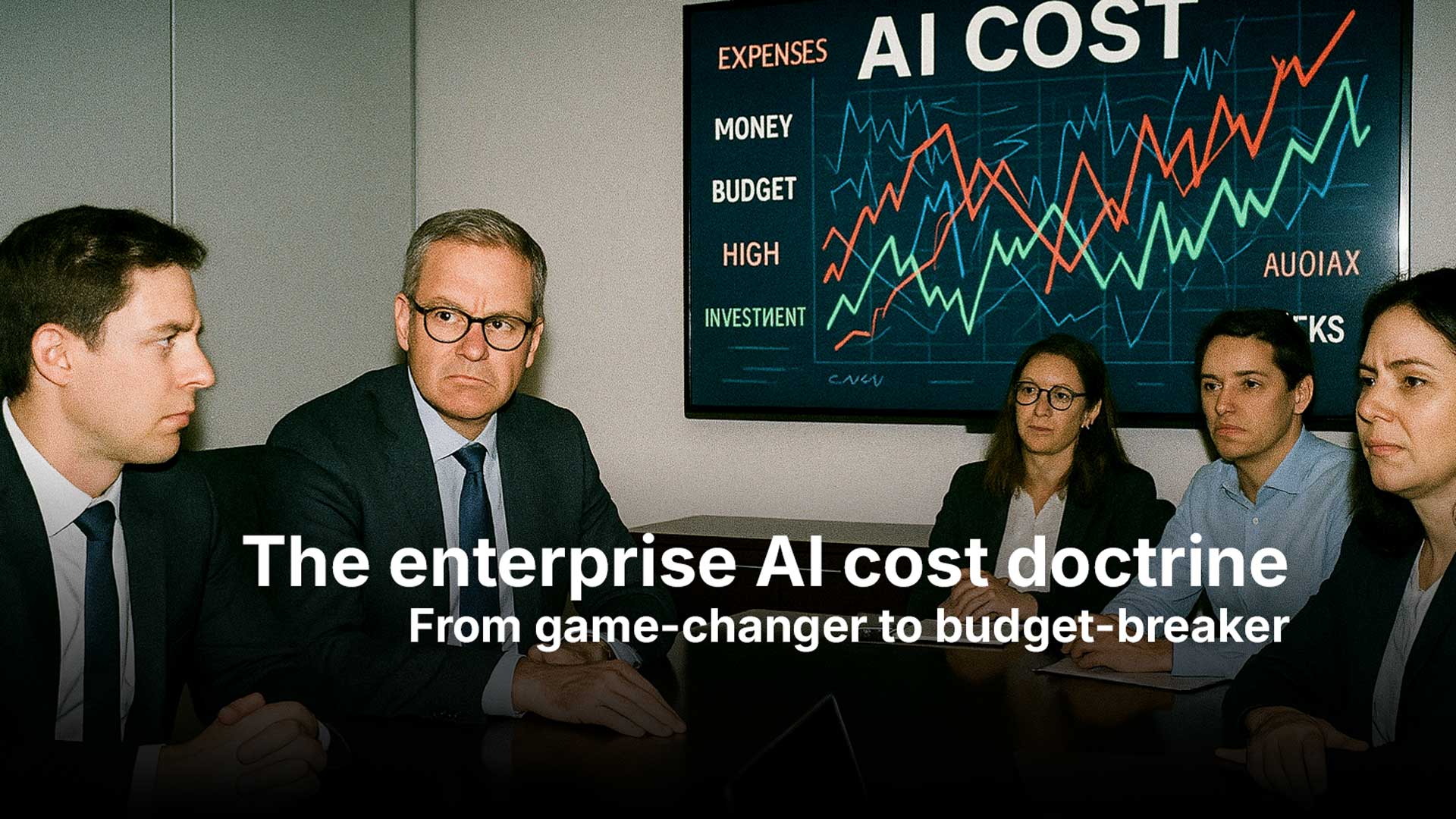
Last quarter, a CFO I advised laughed mid-way through a budget review: “AI saves us money — by spending it faster.”
That line captures our moment perfectly. AI promises transformation, yet its financial reality is more complex than most enterprises admit. Innovation is no longer the hard part; managing its economics is.
The first pillar of the Cronquist Doctrine
If The AI Hangover explored the déjà vu of hype, this article moves into diagnosis — where the money actually goes once AI hits your balance sheet.
This is the first pillar of The Cronquist Doctrine — Cost Architecture — the foundation beneath the AI Capital Efficiency Index (ACEI) I introduced earlier. Where Part 1 addressed the psychology of hesitation, this piece confronts the mathematics of ownership.
Again, AI isn’t a line item; it’s a lifecycle. And every lifecycle has a cost architecture. I break it down into three interlocking layers:
- Visible costs: Licenses, compute, APIs, consulting, data storage. These are easy to quote and even easier to underestimate.
- Recurring costs: Retraining, data refreshes, cloud elasticity, monitoring, compliance. These creep into budgets silently and never leave.
- Hidden costs: Talent churn, integration friction, vendor lock-in, duplicated data pipelines, model drift, and culture fatigue. These are the costs no one budgets for — yet they usually decide whether AI becomes scalable or unsustainable.
Let us dive into the three layers of AI costs…
Quick check for executives
Do you actually know which of these three layers dominates your AI spend?
👉 Download the AI TCO Checklist to map your cost structure before your next budget cycle. (Free executive tool.)
Layer 1 - The visible illusion where AI TCO begins
The visible costs are the entry ticket — hardware, cloud, licenses, and consultants. They’re easy to quote and dangerously incomplete. Most AI pilots look affordable because they hide their future selves.
A €100 000 proof of concept can quietly snowball into €600 000 once inference usage, monitoring, and compliance overheads appear. IDC reports that 70 % of AI projects overshoot their initial budgets by more than 50 %.
The trap is structural. Traditional procurement frameworks expect linear depreciation: you buy servers, you write them off. AI costs behave more like utilities — elastic, variable, and sensitive to every business decision. The more successful your model becomes, the more you pay to serve it. Enterprises that celebrate user growth often wake up to exponential infrastructure invoices.
Another culprit is perpetual prototyping: endless pilots that never die, each consuming a trickle of compute that adds up to a flood.
Visible costs also mislead boards. Because vendors present per model or per call pricing, the illusion of control persists. Until someone connects the dots across business units and discovers that five departments are paying five times for the same API.
What looks like innovation turns out to be parallel experimentation with no cost governance.
Practical advice: Treat every AI proposal like a bond prospectus. Demand lifetime cost estimates, not deployment figures. Ask vendors to model run-rate expenses under three load scenarios — baseline, scale, and peak. If they can’t, they don’t understand your economics.
Layer 2 - The recurring reality where models age and budgets breathe
AI doesn’t depreciate like a server; it ages like milk. Once in production, models demand constant care: retraining, data refreshes, bias monitoring, and security audits. This is the layer where cost turns from event to ecosystem. And where most organizations underestimate by 20–40 %.
The recurring layer punishes those who mistake AI for an automation project. Every model is a living organism and its environment — data, regulation, user behavior — changes daily. Retraining cycles, previously a technical detail, now dominate Opex.
In one Nordic logistics firm, retraining a forecasting model every quarter consumed more budget than its original build. Then came the surprise costs: validation pipelines, third-party audits, fairness testing, and re-certification under the EU AI Act.
Gartner analyst Mary Mesaglio calls this the continuity tax — the price of keeping models trustworthy. Ignore it, and accuracy drifts. React late, and you pay double to rebuild from scratch. Finance teams still treat maintenance as discretionary, but in AI it’s existential.
This is the moment when the denominator (TCO) of the AI Capital Efficiency Index (ACEI) begins to swell faster than its numerator (TVR).
Practical advice: Convert AI maintenance into a subscription mindset. Budget retraining, data refresh, and compliance as predictable line items, not emergency patches. Continuity isn’t overhead; it’s insurance against model decay. And probably the cheapest way to preserve your ACEI score.
Layer 3 - The hidden gravity where AI debt lives
Then come the forces no spreadsheet captures: organizational friction, talent churn, vendor lock-in, and data sprawl. I call this the hidden gravity of AI — the slow pull that bends even healthy projects out of orbit.
In many enterprises, multiple teams quietly rebuild the same thing. McKinsey’s State of AI 2023 report found that 44 % of organizations run overlapping or redundant AI initiatives across business units. Gartner’s Market Guide for AI Engineering Platforms goes further, estimating that duplicated tooling and shadow projects inflate AI operating costs by 20–35 % annually.
In one Nordic case I observed, five departments launched their own chatbots using three different vendors. Each functioned locally, but together they generated over €1 million in redundant annual spend — none of it visible in a consolidated report. That’s how AI debt accumulates: not as a scandal, but as inertia.
Hidden costs also stem from culture. The shortage of experienced AI engineers drives salaries up 25–50 % year-over-year. Every resignation resets project context, forcing expensive onboarding cycles. Meanwhile, data duplication quietly inflates storage bills, and new privacy regulations trigger legal reviews for models trained on legacy data. What began as a €500 000 initiative became a €3 million ecosystem of invisible obligations. Gartner estimates that 30–50 % of AI spend turns into technical or operational debt within two years.
Hidden gravity is dangerous because it’s psychological. Leaders treat these issues as “someone else’s budget.” But across divisions, that someone is everyone — and collectively, it’s the CFO.
Practical advice: Conduct a quarterly “AI Debt Audit”. List duplicate projects, unused APIs, orphaned datasets, and expired licenses. If you can’t see them in one dashboard, they’re controlling you, not the other way around.
The three layers of enterprise AI cost
To see the full breakdown of how the three cost layers interact — and how each shapes your AI Capital Efficiency Index (ACEI) — get the downloadable executive table below.
Simply enter your name and email to access the high-resolution PDF.
From cost to capital discipline
These three layers aren’t isolated. As with anything with AI, they compound. The visible creates the recurring, and the recurring feeds the hidden. When you quantify them together, you don’t just see cost — you see capital behavior.
Again, that’s why I built the AI Capital Efficiency Index (ACEI) — the compass for turning cost discipline into competitive advantage. Where TCO reveals the truth, ACEI measures the performance of that truth. It tells you how efficiently your AI capital actually works over time.
Together, TCO and ACEI form the twin axes of The Cronquist Doctrine — cost discipline and value realization in measurable harmony.
The doctrine in practice
I use a simple rule with clients: if a cost isn’t visible, it’s governing you. The Cronquist Doctrine isn’t about frugality, it’s about freedom. Financial freedom from chaotic innovation.
When leaders map their cost architecture, three things happen:
- They discover that what they called “innovation costs” are actually maintenance.
- They reallocate the budget from redundancy to reinforcement.
- They finally gain predictability — the prerequisite for scaling AI confidently.
This is what I mean by governance as a growth mechanism. Visibility creates velocity. And velocity (when financially disciplined) becomes competitive resilience.
Next step
Most enterprises are already paying the hidden tax of AI Debt, usually without knowing it. The only way to regain control is to see the whole architecture.
👉 Map your AI cost layers today — download the AI TCO Checklist and turn invisible costs into measurable efficiency.
In Part 3 — The AI CFO: Turning Intelligence into Capital Efficiency — I’ll show how financial leaders quantify AI performance using the AI Capital Efficiency Index and govern innovation through the lens of return on intelligence.
Joachim Cronquist is a strategic AI advisor and founder of Cronquist AI. He helps business leaders turn AI into business clarity and measurable results.