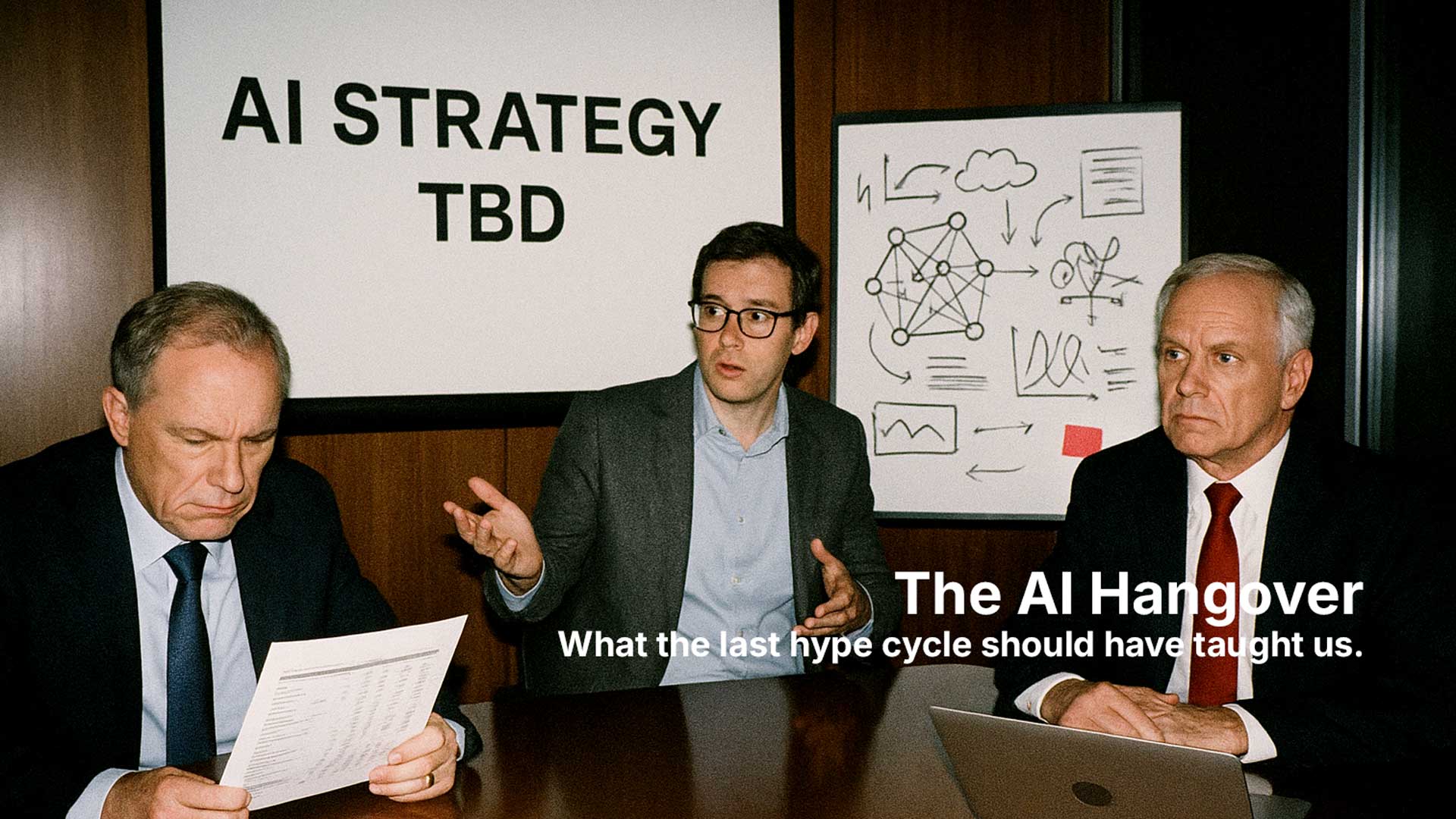
The AI Hangover: Lessons from the Last Hype Cycle


The AI Hangover: Lessons from the Last Hype Cycle

Every generation of business leaders inherits its own form of technological euphoria.

I remember the 1990s, when the internet promised boundless efficiency and unlimited markets. Consultants sold visions of “e-commerce dominance” before most companies had even figured out how to send an order confirmation email. Then came the hangover: overspending, broken systems, and executives asking a simple but painful question:

What went wrong?

Three decades later, the rhythm repeats. Replace “dot-com” with “AI,” and the same fever is back—this time turbo-charged by exponential computing power and generative hype. Once again, boardrooms are full of conviction but short on clarity. Everyone nods when asked if AI will reshape their industry. The silence arrives when I ask when, how and at what cost.

This is the paradox I call the AI hangover: the morning after a hype cycle that hasn’t even ended yet.

Déjà vu in the boardroom

In the late 1990s, CFOs wrestled with the same dilemma they face today: invest early and risk waste, or wait for proof and risk irrelevance. Many waited. They wanted “certainty” before allocating capital. The result was that by the time certainty arrived, competitors had captured the digital high ground.

Today, I see that same caution—this time framed around AI.

In my work with Nordic enterprises, I’ve learned that executives accept AI’s inevitability. Yet hesitate when it comes to funding. They ask: Is it too early? Too risky? Too expensive?

But the question they should ask is: How do we make the cost predictable?

The uncomfortable truth is that AI’s promise and peril both come from the same source: its scale.

A single pilot may look harmless—€50 000 here, a few data scientists there—but once scaled, the cost structure shifts from experiment to enterprise infrastructure. Data pipelines, compute usage, retraining cycles, compliance audits. Each adds weight. Without a cost architecture, the project that began as a proof of concept becomes a proof of confusion.

Again, it happened during the dot-com boom. Companies built digital storefronts without understanding hosting costs, integration complexity, or customer-acquisition economics.

They mistook the presence of technology for the return on it.

Introducing AI Capital Efficiency Index

AI risks repeating that mistake at a higher burn rate. And that’s why I reframe the entire discussion around AI Capital Efficiency:

AI Capital Efficiency Index (ACEI) = Total Value Realization (TVR) / Total Cost of Ownership (TCO)

It’s not about spending less; it’s about spending wisely — maximizing value per invested krona. I’d argue that this mindset separates the survivors of any hype cycle from those who drown in it.


Quick check for executives

Do you actually know your organization’s AI TCO — the full cost across data, talent, and operations?

👉 Download the free AI TCO Checklist to reveal hidden budget leaks before they turn into boardroom surprises.


Why the “cheap AI pilot” hides the true TCO

Let’s be honest: most AI pilots are loss leaders disguised as innovation. They prove that something can work, not that it will scale sustainably. The budgets often cover only what vendors show on the slide—model licensing, cloud fees, and maybe a sprint of development work. What they don’t show are the hidden multipliers that emerge later:

  • Talent scarcity. Senior AI engineers now command salaries rivaling CFOs. Losing one mid-project can reset the schedule by months.
  • Data quality debt. Cleaning, labeling, and governing data can consume 20–30 % of total spend—yet it’s rarely itemized in early budgets.
  • Integration friction. Legacy systems resist change like old bones; connecting modern AI pipelines to them can add 25–60 % in unforeseen costs.
  • Change management. End-user training and process redesign can exceed technical cost three-to-one.

During the internet era, we called this “technical overhead.” In AI, it’s something worse: financial blind spots that scale faster than value.

That’s why CFOs feel uneasy. The spreadsheet looks clean until the sixth month, when invoices begin to pile up from services no one forecasted. In my advisory work, I see the same pattern across sectors: budgets approved on enthusiasm, then doubled under pressure.

When risk has a number and reward has a story

Finance leaders aren’t pessimists—they’re trained realists.

They live in a world where risk is quantifiable and reward is often narrative. AI, however, inverts that logic. Costs are immediate and measurable; value is diffuse and delayed.

The return rarely lands in one dramatic figure. Instead, it seeps across functions: a slightly faster forecast in supply chain, a smoother onboarding in HR, a few fewer hours in finance closing the books.

Valuable, yes—but scattered. And scattered value doesn’t survive budget season.

That’s why many organizations remain stuck in a “wait-and-see” stance. But here’s the irony: the waiting is the cost. While the spreadsheets gather dust, early adopters are building proprietary data flywheels—feedback loops that get stronger every quarter.

More data → better models → more usage → more data.

Once that compounding advantage starts, it’s hard to catch up.

During the dot-com years, we underestimated how quickly digital network effects would cement market leaders. The same dynamic now applies to AI — except the multiplier effect occurs in model performance, not just market share. A competitor who operationalized AI twelve months earlier already owns a year of data you can’t replicate.

From technology to capability

The biggest conceptual trap is treating AI as a project rather than a capability.

Projects end. Capabilities compound.

Think of AI as the new corporate grid—the infrastructure that powers every future efficiency, product, and decision. You don’t justify the electrical network by calculating the ROI of one lightbulb. You justify it because without electricity, nothing else works.

That’s the shift CFOs must make: stop chasing isolated ROI proofs and start designing enduring financial frameworks.

Why?

Because AI doesn’t obey the same budgeting rules as machinery or marketing campaigns. It’s more like human capital—an asset that compounds when nurtured and decays when neglected.

Lessons from the last hype cycle

Looking back at the dot-com era, three lessons stand out. Each is painfully relevant today.

1. Hype hides fundamentals.

In 1999, everyone wanted a website; few asked who would maintain it. In 2025, everyone wants an AI model; few ask who will retrain it. Maintenance is not an afterthought—it’s the cost of staying relevant. McKinsey estimates that model drift erodes 30 % of AI value annually. That means doing nothing has a cost curve of its own.

This clever 1997 IBM ad pokes fun at the internet craze — and reminds us how every technology wave feels the same at the start.

2. Scale amplifies waste.

Early internet ventures discovered that what doesn’t work at a small scale becomes catastrophic at a large one. The same holds for AI. A poorly designed architecture might run fine for 1 000 daily queries but collapse financially at 100 000. IDC’s five-year study shows that predictable workloads run 2.3x cheaper in hybrid environments than in pure public cloud. Choosing wrongly at the start can double your lifetime cost.

3. Fear kills momentum.

After the bubble burst, many companies over-corrected—they avoided digital investment altogether, missing the next wave of efficiency. Today, some executives do the same with AI, mistaking caution for control. But inaction is not neutral; it’s a compounding deficit in capability, culture, and data maturity.

The new financial discipline

Modern CFOs must evolve from budget enforcers to AI capital architects. Their questions shift from “What will it cost?” to “How efficiently do we turn cost into value?

These are not technical metrics; they’re financial instruments. And they can only be calculated through a rigorous Total Cost of Ownership (TCO) model—one that captures the full lifecycle of AI: initial, ongoing, and hidden costs.

TCO turns hype into arithmetic. It exposes where money leaks and where efficiency lives. It transforms AI from a fuzzy strategic bet into a quantifiable investment decision.

When I show a CFO that a single architectural decision—say, deploying predictable workloads in the wrong environment—can create a multi-million cost penalty over five years, hesitation usually turns into clarity. Not because the technology suddenly feels safer, but because the economics finally make sense.

From anxiety to advantage

Every hype cycle leaves behind two kinds of companies: those who chased the promise, and those who built the discipline.

In 2002, the survivors of the dot-com crash weren’t the ones who spent the most on websites. They were the ones who learned to align digital initiatives with real business economics. The same principle now defines the next decade of AI.

AI is inevitable. But its success is not.

The winners will treat AI not as a cost center but as a capital-efficiency engine, using TCO as their compass, and discipline as their firewall. Because if history teaches anything, it’s this:

Hesitation costs more than experimentation.

Your next step

Most organizations I meet are already accumulating invisible AI Debt — hidden costs that erode 20 % of ROI before year one ends. Don’t wait for the invoices to reveal it.

👉 Expose your hidden AI costs — download the AI TCO Checklist and see where your budget leaks before your competitors do.


Joachim Cronquist is a strategic AI advisor and founder of Cronquist AI. He helps business leaders turn AI into business clarity and measurable results.


Loading...

...

Loading...

...