Introducing the AI Capital Efficiency Index — Measuring the True Value of AI Investments
Organizations are making, or planning to make, capital investments in artificial intelligence, driven by the promise of transformational change. However, the true return on these investments remains notoriously difficult to measure. Traditional metrics like Return on Investment (ROI) often fail to capture the full picture, focusing narrowly on immediate financial gains while overlooking strategic benefits and the enormous, often hidden, total costs associated with AI over its lifecycle.
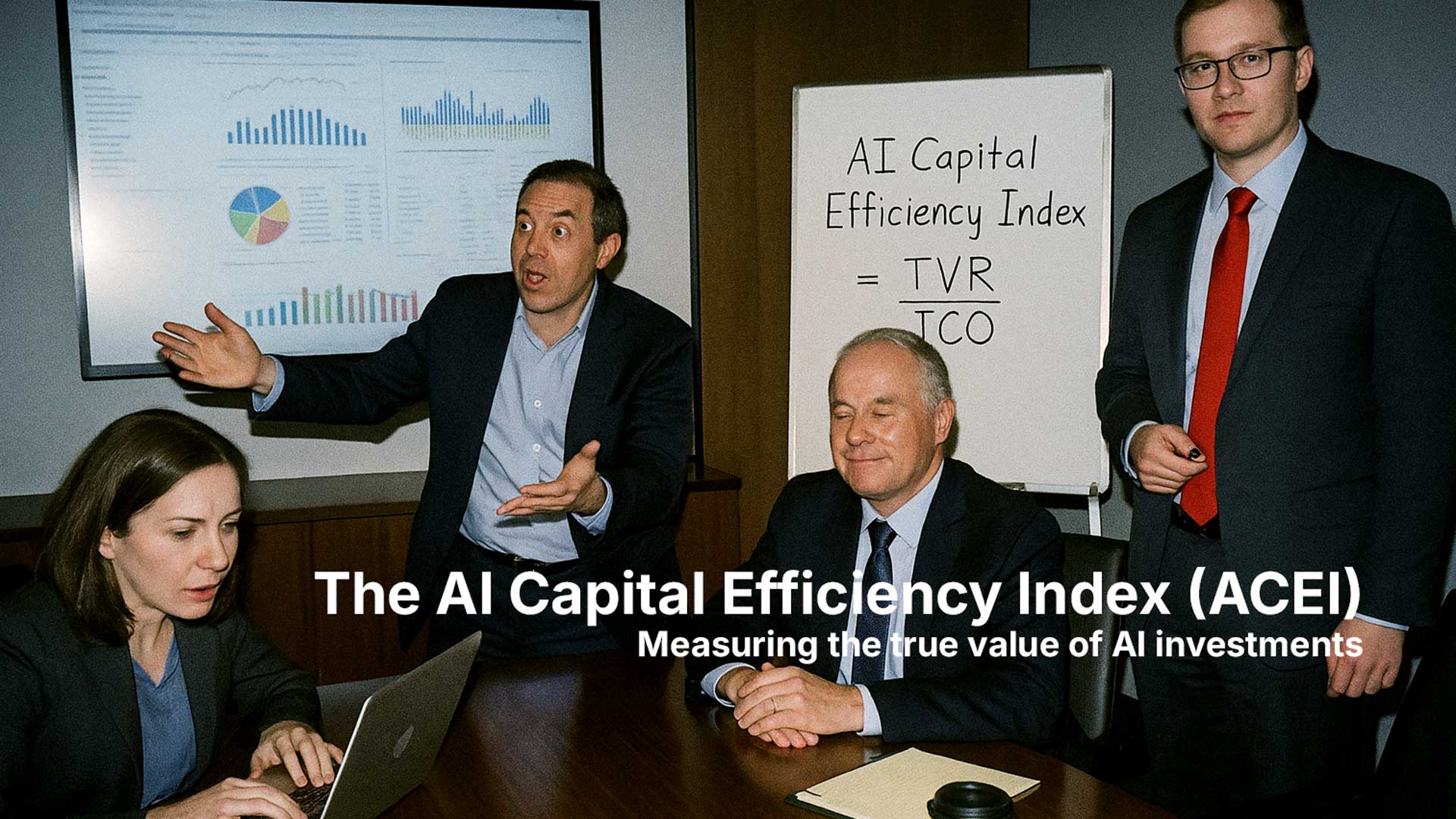
To address this critical gap, I’ve developed a new lens for AI economics — the AI Capital Efficiency Index (ACEI). This powerful new metric is designed to provide a holistic measure of how effectively capital is being used to generate tangible, multi-faceted value from AI initiatives.
As such, the index is the foundation of what I call The Cronquist Doctrine — the union of cost discipline and value realization under one measurable construct.
I see ACEI as a ratio that connects the CFO’s logic of efficiency with the CTO’s pursuit of innovation. And it reframes AI not as a technology expense, but as a capital-allocation discipline.
The logic of the AI Capital Efficiency Index
ACEI is defined by the following equation:
ACEI = Total Value Realization (TVR) / Total Cost of Ownership (TCO)
This index creates a ratio that moves beyond a simple profit-and-loss calculation. It answers a more profound strategic question:
"For every dollar invested over the entire lifecycle of our AI system, how many dollars of total business value are we realizing?"
An ACEI greater than 1 indicates that the realized value exceeds the total cost. However, more importantly, the magnitude of the index provides a clear measure of capital efficiency, allowing for robust comparison across different projects and strategic initiatives.
How efficient is your AI capital really?
Before diving into Total Value Realization, benchmark your current spend structure with the AI TCO Checklist — a free executive tool that reveals the hidden costs shaping your capital efficiency.
The numerator: TVR in the age of AI
Total Value Realization (TVR) is a strategic framework focused on measuring the full spectrum of business outcomes from an investment, not just the direct financial returns. When applied to AI, TVR requires a comprehensive approach that quantifies benefits across several key dimensions:
- Financial outcomes
- Operational improvements
- Customer and stakeholder value
- Strategic advantages
Let us briefly discuss those dimensions.
Financial outcomes
This is the most direct component of value, akin to traditional ROI, but viewed through a broader lens. It includes both cost savings and revenue generation.
Cost savings. AI excels at automating repetitive tasks, optimizing processes, and improving efficiency, leading to significant cost reductions. Key Performance Indicators (KPIs) include reduced operational costs, lower cost per transaction, and savings from fraud prevention.
Revenue growth. AI drives revenue by creating new AI-powered products and services, enhancing existing offerings, and identifying new market opportunities. Relevant KPIs include revenue from new AI-driven services, increased customer lifetime value, and higher market share in new segments.
Operational improvements
This dimension captures the transformative impact of AI on the core workings of the business. It measures gains in efficiency, productivity, and speed that create a more agile and resilient organization.
Productivity and efficiency gains. AI can dramatically reduce the time required for tasks, automate workflows, and augment employee capabilities. This is measured by KPIs such as reduced process cycle times, increased task automation levels, and higher output per employee.
Business agility. AI accelerates innovation and decision-making, allowing companies to respond more quickly to market changes. The value is tracked through metrics like faster time-to-market for new products and a higher velocity in the innovation pipeline.
Customer and stakeholder value
This component measures the impact of AI on external and internal stakeholders, which is a critical driver of long-term growth and loyalty.
Enhanced customer experience. AI enables hyper-personalization, improves service quality, and leads to higher customer satisfaction. This is measured by KPIs like increased Net Promoter Score (NPS), higher customer satisfaction (CSAT) scores, and improved customer retention rates.
Improved employee experience. By automating mundane tasks, AI can free up employees to focus on more strategic, higher-value work, leading to greater job satisfaction and engagement.
Strategic advantages
The most forward-looking dimension of TVR — strategic advantages — captures long-term benefits that position the company for future success. While harder to quantify, these are often the most significant sources of value.
Competitive differentiation. Successful AI implementation can create a significant and sustainable competitive advantage.
Risk mitigation. AI can identify and mitigate risks related to compliance, security, and operations, which has a tangible, albeit indirect, financial value.
Innovation capability. The development of AI expertise and data infrastructure builds an organizational capability that fuels future innovation.
Are you sure you know your true AI costs?
Most organizations underestimate their Total Cost of Ownership by as much as 40%.
Before we break down the denominator of the AI Capital Efficiency Index, take a moment to benchmark your own.
The AI TCO Checklist reveals hidden cost drivers across infrastructure, data, and governance — the same categories that quietly erode capital efficiency.
The denominator: Deconstructing the TCO for AI
The Total Cost of Ownership for AI is a comprehensive financial estimate of all direct and indirect costs incurred throughout the entire lifecycle of an AI system—from conception to decommissioning. Underestimating AI TCO is one of the primary reasons why AI projects fail to scale, as organizations often focus on upfront costs while ignoring substantial long-term expenses.
A robust AI TCO model must include the following components:
- Acquisition and development costs (upfront costs)
- Implementation and integration costs
- Operational and maintenance costs (ongoing costs)
- Hidden and indirect costs
Let me walk-through the above components.
Acquisition and development costs
These upfront costs are the initial capital expenditures required to get an AI project off the ground.
- Hardware and infrastructure includes the high cost of specialized hardware like GPUs and TPUs, as well as servers and storage, whether on-premises or in the cloud.
- Software and licensing covers licensing for AI platforms, development tools, and fees for using pre-trained models or APIs (e.g., token costs for large language models).
- Data acquisition and preparation. High-quality data is the lifeblood of AI. Costs in this area can be substantial, including purchasing datasets, data cleaning, labeling, and storage.
- Talent acquisition. AI projects require specialized and expensive talent, including data scientists and AI engineers.
Implementation and integration costs
These are the one-time costs associated with deploying the AI system and integrating it into existing workflows.
- System integration involves the complex work of connecting the AI solution with legacy systems, which can involve custom API development and architectural overhauls.
- Training and change management. Employees must be trained to use the new AI tools effectively. This also includes the cost of managing the disruption to existing workflows as the organization adapts.
Operational and maintenance costs
The ongoing costs are the recurring expenses required to run, maintain, and govern the AI system over its life. It is often the most underestimated category.
- Compute costs. While model training is expensive, the ongoing cost of running the model to make predictions can be even greater, especially at scale. This includes infrastructure costs and API usage fees.
- Maintenance and upgrades. AI models are not static; they require continuous monitoring for "model drift" and periodic retraining to remain accurate, which consumes significant resources.
- Governance and compliance. As regulations like the EU AI Act emerge, there are growing overhead costs associated with ensuring AI systems are transparent, fair, and compliant.
Hidden and indirect costs
Hidden and indirect costs are the often-overlooked costs that can have a major impact on the true TCO.
- Environmental costs. AI data centers consume massive amounts of energy and water for cooling, leading to a significant carbon footprint and high utility bills that are often buried in cloud service fees.
- "AI debt". Poorly architected AI systems create a form of technical debt that is more insidious than its traditional counterpart. This includes complex system dependencies, documentation challenges, and continuous evaluation demands that can inflate future costs.
- Cybersecurity and risk. AI systems introduce new vulnerabilities and require investment in enhanced security measures to protect against data breaches and adversarial attacks.
Applying the AI Capital Efficiency Index (ACEI)
The ACEI is more than a formula, it is a strategic discipline. And by calculating and tracking the AI Capital Efficiency Index, organizations can:
- Make smarter investment decisions. The index provides a standardized metric to compare the relative efficiency of different AI projects or vendors. A project with a lower upfront cost might have a much lower ACEI if its TCO is high and its realized value is limited to a narrow set of outcomes.
- Drive strategic alignment. The process of defining the TVR components forces a crucial conversation about how an AI initiative aligns with broader business goals. This prevents the common pitfall of pursuing "AI for AI's sake".
- Optimize performance over time. The ACEI is not a one-time calculation. By tracking it continuously, leaders can identify when an AI system's value is diminishing or its costs are escalating, prompting interventions to optimize performance and improve efficiency.
- Justify and secure funding. By demonstrating a high ACEI on pilot projects, technology leaders can build a powerful, data-driven business case to secure funding for scaling AI initiatives across the enterprise. It moves the conversation with the CFO from "What will it cost?" to "What is the efficiency of our capital deployment?"
In conclusion, the AI Capital Efficiency Index (ACEI) brings structure to the messy economics of artificial intelligence. It balances what you gain — Total Value Realization — against what you spend — Total Cost of Ownership. With that lens, leaders can see past the hype, expose hidden costs, and make smarter, data-driven choices. The result: AI investments that don’t just impress, but perform — delivering efficiency, predictability, and lasting business value.
To help you start, I created the AI TCO Checklist — a free diagnostic that uncovers the hidden cost drivers shaping your efficiency.
Use it to benchmark your current spend, strengthen your next investment case, and take the first step toward improving your own AI Capital Efficiency Index.
Joachim Cronquist is a strategic AI advisor and founder of Cronquist AI. He helps business leaders turn AI into business clarity and measurable results.