The automation paradox: replace people or release their potential?
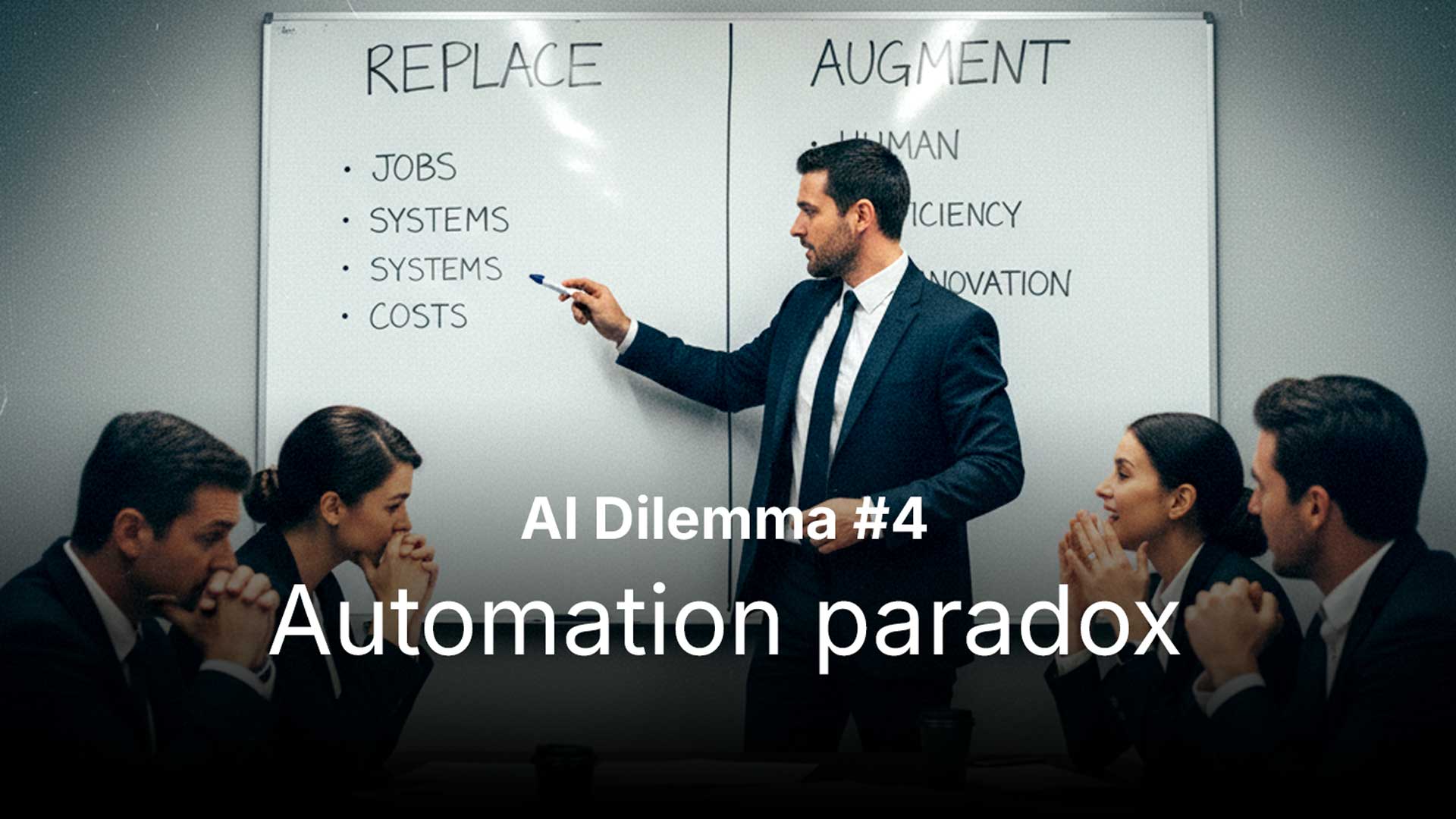
For years, automation has promised freedom — freedom from tedious work, from cost, from inefficiency. Yet every wave of automation ends up reviving the same anxiety: Are we replacing people, or are we releasing their potential?
The truth depends less on technology and more on intention.
In most boardrooms, automation is framed as an efficiency play.
The business case is clean: faster processes, lower headcount, better margins. It’s the mechanical logic of the industrial age — squeeze more output from less input.
But AI changes the equation.
Instead of merely replicating human effort, it can amplify human capability. That subtle shift — from replacement to reinforcement — separates the organizations that gain a short-term bump from those that gain a lasting advantage.
Imagine two companies...
One uses AI to replace its slowest performers. Costs fall. Productivity rises — for a while. The other uses AI to elevate its best performers: to give them sharper insight, faster feedback, deeper reach. Costs rise slightly, but value multiplies.
The first firm automates people out of the system. The second automates people up in the system.
Automation aimed downward creates fragility. When the only lever is efficiency, you eventually run out of room to cut. Automation aimed upward creates resilience. It unlocks learning, curiosity, and entirely new forms of contribution. It turns A-players into designers of new playbooks.
Of course, idealism has limits.
No company can automate purely for inspiration; shareholders still expect the spreadsheet to smile. The challenge is balance: use automation to clear low-value work while reinvesting that time into higher-value creativity. Otherwise, the same AI that saves costs today quietly erodes tomorrow’s capability.
Leadership, then, becomes an act of design
Which human experiences do we want to preserve, and which can safely fade into the background? What kind of culture emerges when machines handle routine decisions? Do we measure success by the number of roles reduced — or by the number of new roles made possible?
This is the paradox: AI gives us tools to replace people faster than ever, precisely at the moment when we need people’s judgment more than ever.
Automation can make us more efficient. But only purpose can make us better.
The companies that thrive won’t be the ones that automate the most — they’ll be the ones that automate with intention. The ones that see each algorithm not as a substitute for human talent, but as an instrument for human growth.
Because the real promise of automation isn’t in cutting what humans do. It’s in expanding what humans can do.
Or?
Joachim Cronquist is a strategic AI advisor and founder of Cronquist AI. He helps business leaders turn AI into business clarity and measurable results.
Loading...
...
Loading...
...