The ROI focus: when “good enough” becomes the enemy of great
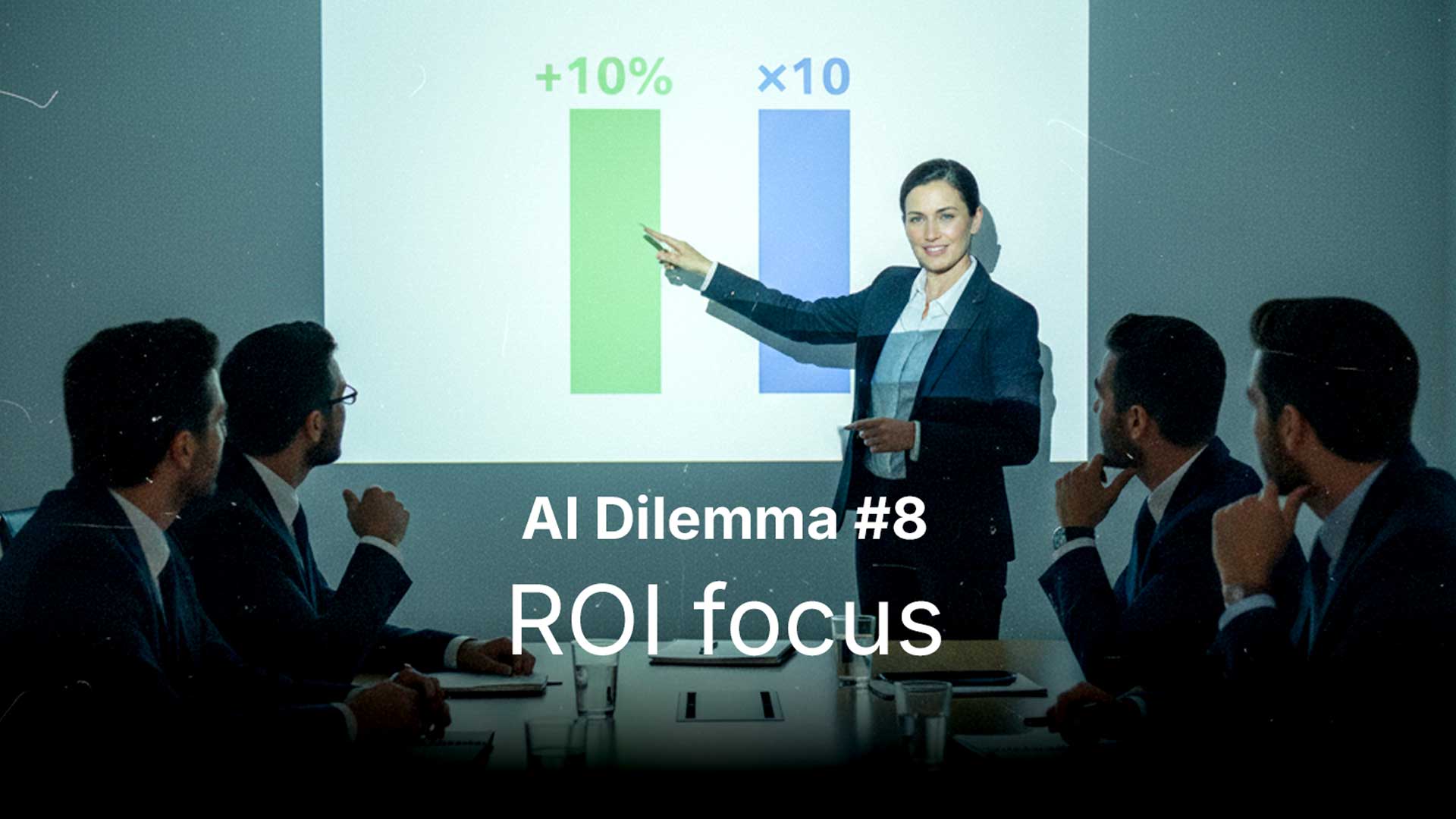
Most organizations say they want transformation. What they usually mean is improvement. Ten percent faster. Ten percent cheaper. Ten percent safer.
The steady hum of optimization feels responsible — data-driven, shareholder-friendly, controllable...or?
But then AI entered the equation, and the arithmetic broke. Because AI doesn’t just tweak the old model — it invents new ones. It doesn’t politely nudge a process forward; it redefines what the process is.
And suddenly, leaders face a strange calculus: chase 10 percent better everywhere, or gamble on 10× better somewhere.
The first option feels safe.
You can track it, audit it, and present it at the next quarterly call. The second feels reckless — because it usually starts as an expense, not a return. Ten percent projects make CFOs comfortable. Ten-times projects make them nervous.
The nervous ones who went first
Yet history is mostly written by the nervous ones who went first. Netflix didn’t aim to make Blockbuster’s rentals ten percent faster. Tesla didn’t want slightly cleaner cars. When technology rewrites the rules, small efficiencies rarely survive the rewrite.
And still, there’s wisdom in restraint.
For every 10× vision that changed an industry, a dozen quietly died in pilot purgatory. The promise of exponential return can seduce leaders into forgetting the cost of experimentation — the cultural fatigue, the data debt, the opportunity cost of chasing the next shiny thing.
That’s a paradox of the AI era: ROI itself is evolving.
Return is no longer purely financial; it’s also adaptive — the ability to learn faster than competitors. Investment is no longer just capital; it’s attention, trust, and talent bandwidth.
And the “I” in ROI increasingly means intelligence — both human and artificial — deployed wisely.
The real dilemma?
So perhaps the real dilemma isn’t 10 percent vs 10x. It’s whether leaders measure AI success in quarters or capabilities.
Do you optimize for visible wins, or for invisible learning that compounds over time? Do you count the savings today, or the strategic options you’ve created for tomorrow?
Neither path guarantees survival. The cautious risk stagnation; the bold risk implosion. But both, at their best, are searching for the same thing — clarity about value in a world where value itself keeps mutating.
Maybe the future of ROI is less about “return on investment” and more about “return on imagination.” Because imagination — disciplined, data-literate, commercially grounded imagination — may turn out to be the only multiplier left.
So, ten percent or ten times?
Both can be right. Both can fail spectacularly. What matters is whether your organization knows why it’s choosing one over the other — and whether your leadership culture can live with the consequences.
Or?
Joachim Cronquist is a strategic AI advisor and founder of Cronquist AI. He helps business leaders turn AI into business clarity and measurable results.
Loading...
...
Loading...
...